

The Story Behind Our New Sous Vide Journey
In our kitchen, we've always leaned toward deeply traditional methods—the kind of cooking that relies on instinct, patience, and a lifetime of repetition. So even though sous vide has been used in Michelin-star kitchens around the world for over a decade, we never took it all that seriously.
Not because we were trying to save money on equipment.
Not because we didn't believe in it.
Simply because we trusted our hands, our pans, and our senses.
For years, when we did need to sous vide something, we did it the old-fashioned way: bring water to temperature, check it with a thermometer, adjust the heat, add a splash of cold water, wait, check again. Not perfect, but it worked—and it taught us patience.
But before we go further, here's the part most guests never see
What is sous vide, really?
Sous vide is a cooking method where food is sealed in a bag and placed in a precisely controlled water bath. The temperature stays consistent—not fluctuating like a stovetop or oven—which means the food cooks evenly from edge to center. No overcooking, no guesswork, no "close enough."
It's slow, gentle, and incredibly precise.
Think of it as the difference between painting freehand and using a ruler—both can be beautiful, but one gives you perfect lines every time.
Why we finally embraced it
Recently, we were hired for a catering event in January where we'd be serving a multi-course dinner. The kind of event where consistency isn't just important—it's everything. Every plate needed to be just as tender, just as juicy, and just as flavorful as the one before it.
The menu featured:
- First course: Prosciutto & mixed greens salad
- Main course: A meat platter with 3oz bacon-wrapped pork, chicken roulade, and sirloin steak
- Multiple sides and accompaniments
So we started researching. And sous vide kept coming up. Again and again.
Not as a trend—but as the most reliable way to deliver perfect results at scale.
A couple of Fridays before our event we decided to stop being stubborn and give it a real try.
We invested in two units:
- the Breville Joule Turbo
- and the Atmovac SV310 by Eurodib—a serious piece of equipment built for real kitchens
The test: 129°F for two hours
Why 129°F specifically? Because that's the sweet spot for medium-rare steak—warm enough to render fat and break down connective tissue, but not so hot that proteins seize up and squeeze out moisture. At 129°F, the muscle fibers relax, the intramuscular fat melts into the meat, and you get that edge-to-edge pink doneness that's nearly impossible to achieve any other way.
Traditional methods—stovetop, oven, even reverse-sear—rely on heat moving from the outside in. By the time the center reaches 129°F, the outer layers have already climbed past 140°, 150°, sometimes higher. That's where you get the gray band. The overcooked edge. The dry exterior around a perfect center.
With sous vide, the entire steak reaches 129°F—and stops there. No temperature gradient. No gray band. Just consistent, edge-to-edge doneness.
We tested them on 16 steaks.
Two hours at 129°F.
Rapid chill in an ice bath.
Refrigerate.
Sear to order.
The ice bath is critical. Shocking the steaks in ice water immediately after sous vide stops the cooking process and locks in that perfect doneness. It also lets you refrigerate them safely—fully cooked, ready to sear when needed—without any risk of continuing to cook or losing texture.
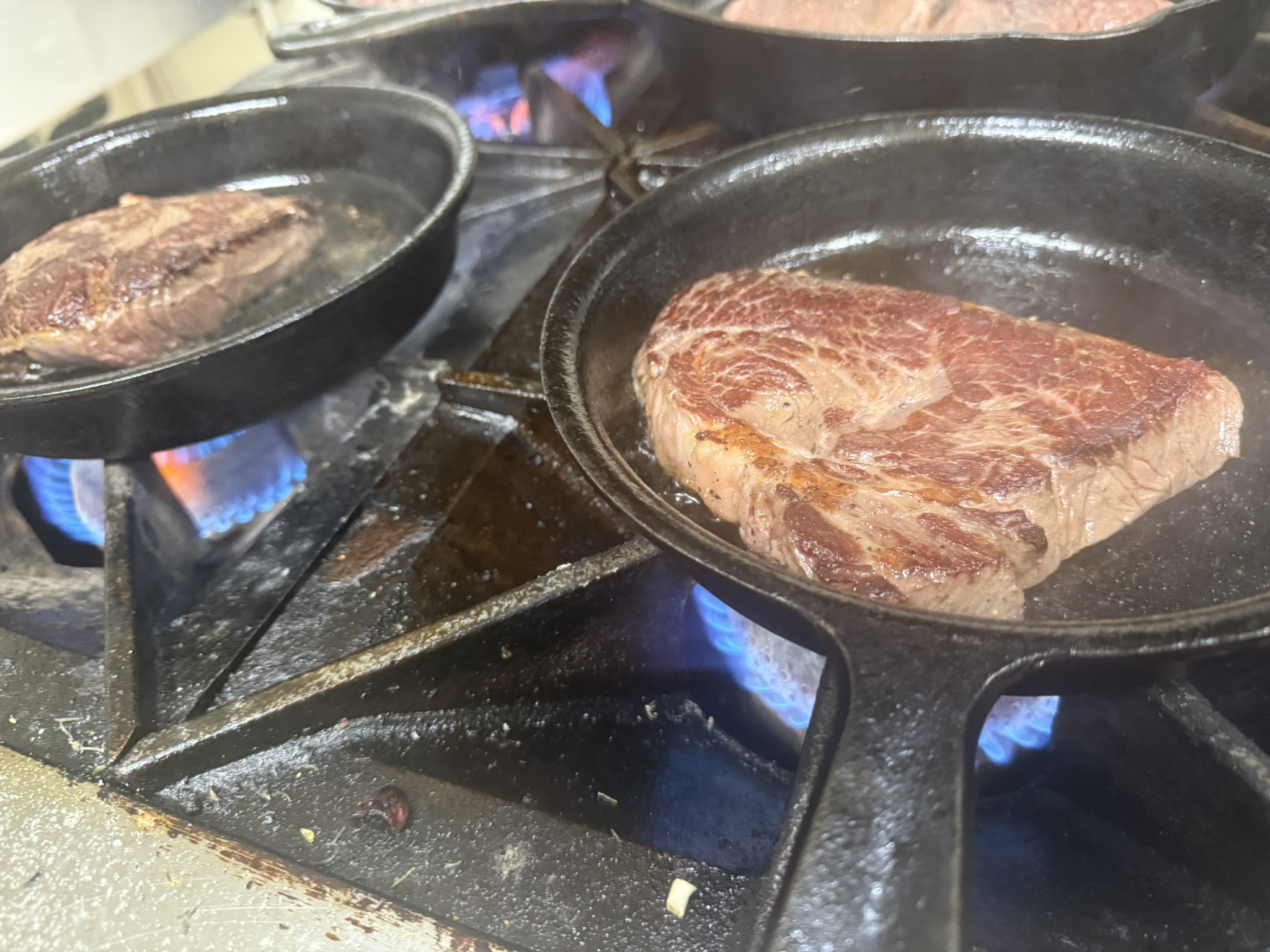
The final step: a hard sear in screaming-hot cast iron
The sear: where crust meets precision
Here's the thing sous vide can't do: create a crust.
That deep, caramelized, nearly-burnt exterior that makes a steak unforgettable? That comes from the Maillard reaction—a chemical transformation that only happens at temperatures well above 300°F. Sous vide never gets close.
So after the steaks came out of the ice bath and rested in the fridge, we patted them completely dry—moisture is the enemy of a good sear—and heated our cast iron pans until they were smoking hot. Not warm. Not hot. Smoking.
We seared each steak for about 60 to 90 seconds per side. Just long enough to build that dark, crackling crust. Because the interior was already perfectly cooked, we didn't need to worry about timing or carryover heat. The only goal was color, texture, and flavor.
The result? A steak with a charred, crispy exterior and a perfectly pink, impossibly tender interior—no gray band, no guesswork, no compromise.
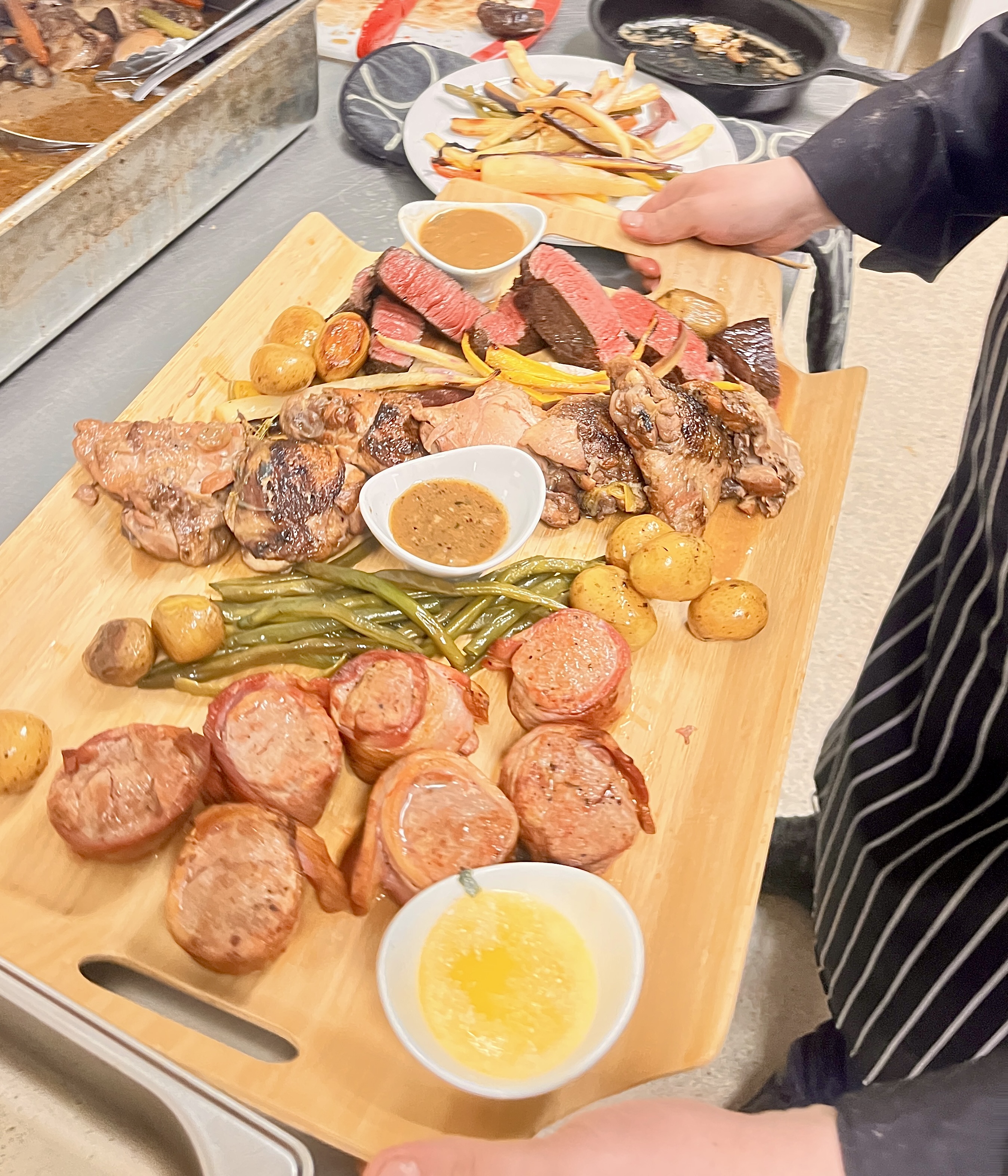
Edge-to-edge perfection: no gray band, just consistent doneness throughout
The results were… beyond amazing.
The texture was velvet-soft, edge to edge.
The tenderness was unreal—no guesswork, no overcooking, no "hot spots."
The flavor was deeper and more concentrated than anything we'd achieved with traditional methods like pan-sear-and-finish, oven roasting, cast-iron basting, or reverse-sear.
Sous vide didn't replace our craft—it elevated it.
And then we kept going
After that first test, we didn't stop.
We cooked brisket that sliced like butter.
Tenderloin that stayed perfectly rosy from top to bottom.
Chicken roulade that held its shape and stayed impossibly juicy.
Even our potatoes went into the bath—and came out better than ever.
At the event, sous vide became our greatest ally.
It gave us control, consistency, and confidence from the first plate to the last.
We ended up cooking almost everything sous vide—except our bacon-wrapped pork and a few other items—and the results spoke for themselves.
What this means for you at Gems
This wasn't just about one catering event. It was about discovering a tool that changes what we can offer you.
At Gems, we're now using sous vide to deliver the kind of consistency and precision that used to be reserved for high-end restaurants with massive kitchen teams. When you order our steak, it's cooked sous vide to perfect medium-rare, then seared to order when you sit down. That means whether you're the first table of the night or the last, your steak will have the same edge-to-edge doneness, the same tenderness, the same deep flavor.
We're using it for chicken breast that stays juicy instead of drying out. For pork that's tender without being undercooked. For vegetables that hold their texture and flavor in ways roasting or steaming can't match.
It also gives us better control over timing. In a small kitchen with limited staff, sous vide lets us prep ahead without sacrificing quality. Your meal still comes out fresh, perfectly cooked, and exactly when you need it—but we're no longer racing against the clock every single night.
Can you do this at home?
Honestly? Yes. And you should.
You don't need a $1,200 unit. Consumer-level sous vide circulators like the Anova start around $100-150, and the Breville Joule Turbo we tested costs $379. Both work beautifully for home cooking. Vacuum sealers are helpful but not required—heavy-duty zip-top bags work fine if you use the water displacement method to remove air.
The technique is the same whether you're cooking two steaks or two hundred:
- Season your meat
- Seal it in a bag
- Set your water bath to 129°F (or whatever temperature suits your doneness preference)
- Cook for 1-2 hours
- Pat dry, then sear hard and fast in a screaming-hot pan
Where sous vide really shines for home cooks is forgiveness. You can't overcook a steak at 129°F—it'll never go above that temperature. Leave it in for an extra 30 minutes? It'll be fine. That kind of flexibility is invaluable when you're juggling dinner, kids, or just life.
That said, sous vide isn't magic. It won't fix bad ingredients, and it won't replace technique. But for achieving consistent, restaurant-quality results at home? It's one of the best investments you can make.
A new tool with an old soul
Now, the Atmovac SV310 has earned a permanent place in our kitchen.
Not because it's trendy.
Not because it's modern.
But because it helps us deliver the kind of food we believe in—food made with intention, precision, and heart.
Sometimes the tools you resist the longest become the ones you rely on the most.